Invent, Reinvent, Thrive by Lloyd Shefsky
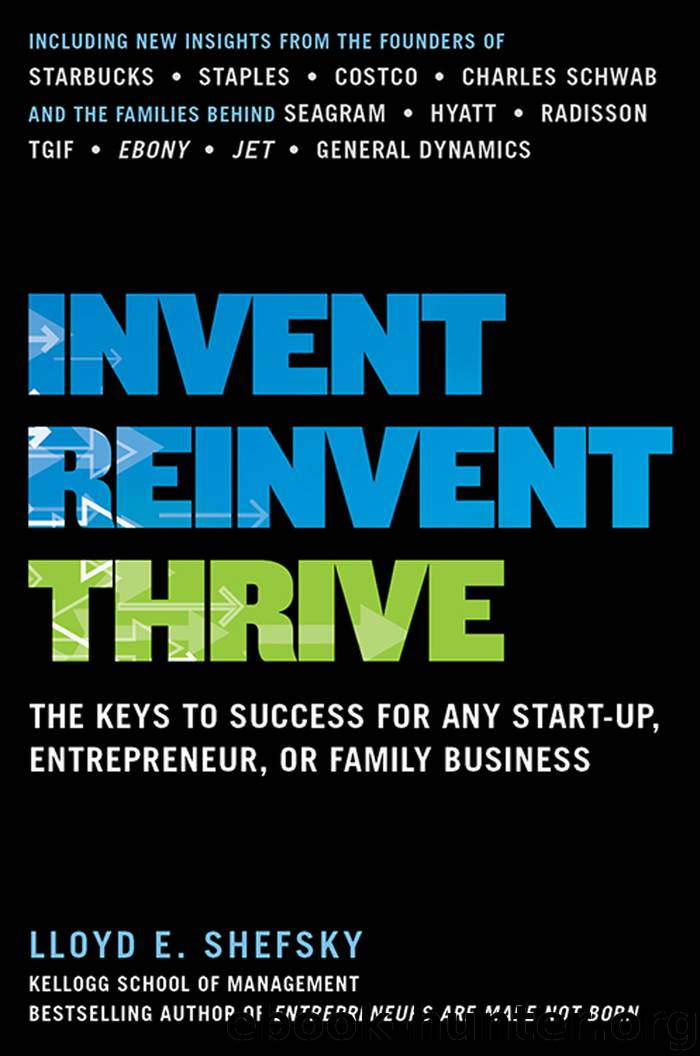
Author:Lloyd Shefsky
Language: eng
Format: epub
Publisher: McGraw-Hill Education
Published: 2014-03-15T16:00:00+00:00
A Culture of Arrogance
Sometimes it is the very confidence that enabled a company founder to block out the noise, reinvent himself, challenge the world, and make his dream child an industry leader that becomes the enemy. Confidence becomes arrogance, and arrogance results in the company’s slide or even its destruction. Often, decades or even an entire century after its founding a company will develop a culture of arrogance. This may not be tied so much to its founding or even to its founder. Instead it may be born out of its successes. The arrogance can be unrelated to the founder’s confidence. This destructive arrogance can take hold long after the founder is gone.
Such arrogance can prevent a company’s reinvention when that step is essential. Having dominant market share can cause one to “ignore the kid with the slingshot” and to decide that there is no need to reinvent. Kodak and IBM are prime examples of this, although in Kodak’s case it was both David and Goliath. Unfortunately, these examples are not unique; fortunately, however, the failings of these two companies are not the norm.
IBM was a rarity in its earlier years. There weren’t many companies that could be characterized as computer companies. Indeed, there weren’t that many computers. In the 1950s and 1960s, a computer was a gigantic contraption that filled a 40- by 40-foot room, and the room required air conditioning 24/7, though that phrase was invented decades later. Few Americans knew how to use these computers. Computers, though large in size, were puny in function by today’s standards. They only did limited computing and data crunching. A major institution was fortunate to have one computer. There were many universities that had none.
In the late 1950s and early 1960s, I was a student, employed part-time by my school. My boss was a brilliant woman working on her PhD at the University of Chicago. Part of my job was to work on the statistical analyses for her thesis. The deadlines were tight. We had to have our work finalized in time for her to run the data during the one hour per month when she was afforded access to the college’s one computer.
In a world with so few users and so few manufacturers of computers, IBM couldn’t afford to make any mistakes. The company was an amazingly well-organized and disciplined one, from training, to sales techniques, even to dress code. Its rules were geared to prevent the necessity for its people to think about unnecessary matters, so they could focus on important problems and “keep their eye on the ball.” I mention this because I want to dispose of any notions of arrogance in the usual sense. This was a company that owned a huge piece of the market, but certainly not all of it. It had competition from UNIVAC, which was much smaller. IBM was more like an oligopoly than a monopoly. Not that it would likely have been attacked as a monopoly, since the government was one of the company’s most eager customers.
Download
This site does not store any files on its server. We only index and link to content provided by other sites. Please contact the content providers to delete copyright contents if any and email us, we'll remove relevant links or contents immediately.
Hit Refresh by Satya Nadella(9141)
The Compound Effect by Darren Hardy(8978)
Change Your Questions, Change Your Life by Marilee Adams(7788)
Nudge - Improving Decisions about Health, Wealth, and Happiness by Thaler Sunstein(7712)
The Black Swan by Nassim Nicholas Taleb(7137)
Deep Work by Cal Newport(7090)
Rich Dad Poor Dad by Robert T. Kiyosaki(6646)
Daring Greatly by Brene Brown(6520)
Principles: Life and Work by Ray Dalio(6464)
Playing to Win_ How Strategy Really Works by A.G. Lafley & Roger L. Martin(6321)
Man-made Catastrophes and Risk Information Concealment by Dmitry Chernov & Didier Sornette(6027)
Big Magic: Creative Living Beyond Fear by Elizabeth Gilbert(5780)
Digital Minimalism by Cal Newport;(5769)
The Myth of the Strong Leader by Archie Brown(5513)
The Slight Edge by Jeff Olson(5421)
Discipline Equals Freedom by Jocko Willink(5393)
The Motivation Myth by Jeff Haden(5216)
The Laws of Human Nature by Robert Greene(5214)
Stone's Rules by Roger Stone(5091)
